
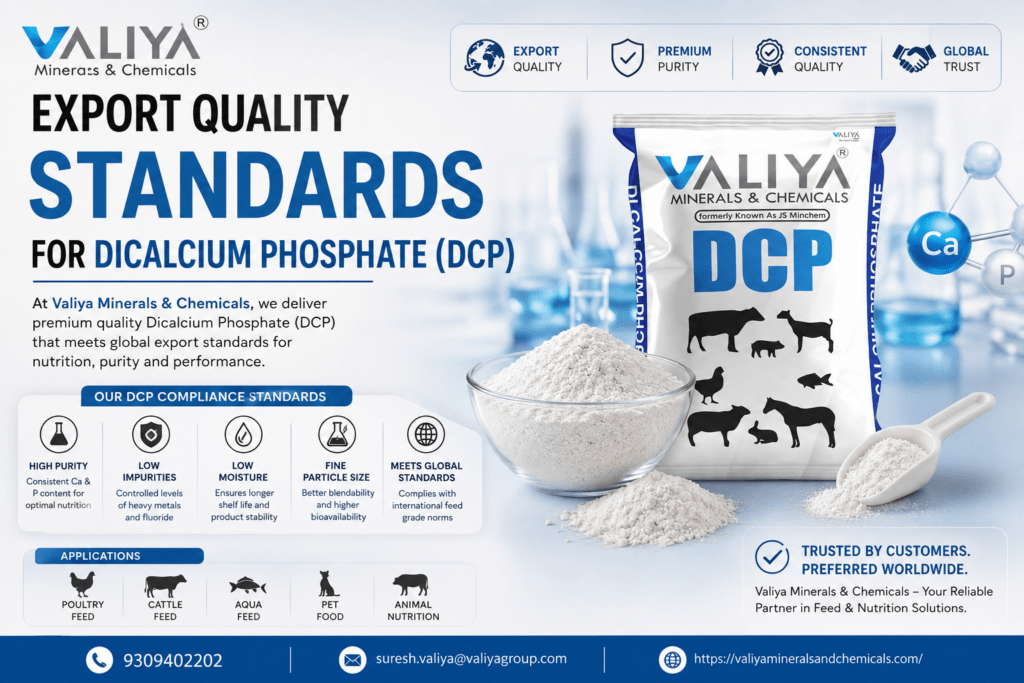
The global animal feed and fertilizer industry depends heavily on consistent and verified raw material quality. Among the most widely traded mineral supplements in international markets, Dicalcium Phosphate holds a position of critical importance. For any exporter, trader, or manufacturer operating in this space, understanding and meeting DCP Export Quality Standards is not a choice — it is a business necessity. Countries importing DCP demand strict compliance with compositional purity, heavy metal limits, moisture levels, and packaging specifications before approving any shipment. Whether you are supplying to Europe, the Middle East, Southeast Asia, or Africa, your product must meet internationally recognized DCP Export Quality Standards at every checkpoint. As a trusted Dicalcium Phosphate Manufacturer in India, Valiya Minerals is one of India’s leading names in producing export-grade Dicalcium Phosphate that consistently meets global compliance benchmarks across all major international markets. In this blog, we walk you through every important aspect of DCP Export Quality Standards in a clear and systematic manner.
Step 1: What is Dicalcium Phosphate and Why Export Quality Matters
Dicalcium Phosphate, commonly known as DCP, is an inorganic compound with the chemical formula CaHPO4. It is widely used as a mineral supplement in poultry, cattle, swine, and aquaculture feed to provide essential calcium and phosphorus for healthy bone development and metabolic function. DCP is also used in fertilizers, toothpaste manufacturing, and certain pharmaceutical applications. Because it directly enters the animal feed supply chain, the quality of DCP has a direct impact on animal health, productivity, and ultimately human food safety. This is why DCP Export Quality Standards are defined so strictly by importing countries and international regulatory bodies. Any deviation from approved compositional limits, contamination thresholds, or physical specifications can result in shipment rejection, financial penalties, or permanent blacklisting from key export markets. For every Dicalcium Phosphate Manufacturer in India looking to build a strong and sustainable presence in global markets, understanding DCP Export Quality Standards from the very beginning of the production and procurement process is the only way to ensure consistent market access and long-term export success.
Step 2: Key Chemical Composition Requirements in DCP Export Quality Standards
The foundation of all DCP Export Quality Standards is the chemical composition of the product. Buyers and importing regulatory authorities evaluate DCP against well-defined limits for every major and minor constituent. The primary parameters assessed include the following. Phosphorus content expressed as P is typically required to be a minimum of 18 percent on a dry matter basis for feed-grade DCP. Calcium content expressed as Ca is generally required to fall between 21 and 24 percent. Moisture content must be controlled strictly below 4 percent to prevent caking, microbial growth, and degradation during transit. Fluorine content is one of the most tightly regulated parameters — international guidelines typically require fluorine to be below 0.18 percent as excess fluorine is toxic to animals. The Ca to P ratio must fall within the acceptable range of approximately 1.3 to 1.4. Any Dicalcium Phosphate Manufacturer in India must verify these compositional benchmarks through accredited laboratory testing before every export consignment to maintain full compliance.
Step 3: Heavy Metal Limits Under DCP Export Quality Standards
One of the most scrutinized aspects of DCP Export Quality Standards is the control of heavy metal contamination. Since DCP is derived from phosphate rock, it can carry trace levels of naturally occurring heavy metals that become dangerous if present above permitted thresholds in animal feed. Major importing regions including the European Union, Gulf Cooperation Council countries, and ASEAN nations have established strict maximum limits for heavy metals as part of their compliance frameworks. Lead content must be below 10 mg per kg in most markets. Arsenic must be controlled below 10 mg per kg. Cadmium limits are even stricter, typically below 10 mg per kg, with the European Union maintaining particularly tight regulations on cadmium in phosphate-derived products. Mercury must be below 0.1 mg per kg. Chromium and nickel measurements are also assessed in many markets. Meeting these heavy metal thresholds requires sourcing phosphate rock from verified low-contamination deposits and maintaining rigorous process controls throughout production — both central to genuine compliance with DCP Export Quality Standards.
Step 4: Physical and Granulometric Specifications in DCP Export Quality Standards
Beyond chemical composition, DCP Export Quality Standards also define strict physical characteristics that determine the product’s suitability for specific end-use applications. Physical specifications are especially important for feed mill operators who blend DCP into compound feed formulations using automated mixing and dosing equipment. Particle size distribution is a key physical parameter — most feed-grade DCP for export must pass through a mesh size of 250 microns with a minimum of 90 percent passing, though specific requirements vary by market and application. Bulk density is typically specified between 700 and 900 grams per litre for granular forms and between 600 and 800 grams per litre for powder forms. Color is specified as white to off-white, and the product must be free from visible impurities, foreign matter, lumps, and discoloration. Flowability must be adequate to allow smooth handling in automated feed production lines. Every serious DCP Manufacturer in India must verify these physical specifications through standardized test methods before each shipment to ensure full compliance with the destination market requirements.
Step 5: Microbiological Standards Under DCP Export Quality Standards
Microbiological safety is an increasingly important component of DCP Export Quality Standards, particularly for DCP used in animal feed destined for export to Europe, North America, and regulated Asian markets. While DCP is an inorganic mineral compound, cross-contamination during processing, handling, or packaging can introduce harmful microorganisms that compromise feed safety. Key microbiological parameters include total plate count, which should be below 50,000 CFU per gram for most markets. Salmonella must be completely absent in 25 grams of sample — zero tolerance is the standard enforced by the EU, GCC, and most other major importing regions. E. coli must be below 10 CFU per gram. Mould and yeast counts should be controlled below 500 CFU per gram to prevent spoilage during storage and transit. Achieving these microbiological benchmarks requires maintaining hygienic manufacturing conditions, using food-grade packaging materials, conducting regular environmental monitoring, and testing every export batch through accredited third-party laboratories as required by international trade regulations.
Step 6: International Certifications Required for DCP Export Quality Standards Compliance
Meeting DCP Export Quality Standards is not just about the product itself — it also requires obtaining and maintaining the right international certifications that importing authorities accept as proof of compliance. Without these certifications, even a technically compliant product cannot clear customs in many regulated markets. The most important certifications include ISO 9001 for quality management systems, which demonstrates that the manufacturer has systematic controls in place for consistent production. GMP Plus certification, developed in the Netherlands and widely recognized across Europe, is essential for DCP exported to EU member countries. FAMI-QS certification is another European feed additive quality assurance scheme increasingly required by importers. Halal certification is mandatory for exports to Middle Eastern and Muslim-majority countries. Kosher certification may be required by certain buyers in North America and Europe. Every Dicalcium Phosphate Manufacturer in India seeking to export must hold all relevant certifications applicable to their target markets and specific buyer requirements.
Step 7: Packaging and Labelling Requirements Under DCP Export Quality Standards
Proper packaging and accurate labelling are integral components of DCP Export Quality Standards that are often overlooked by inexperienced exporters. International buyers and customs authorities evaluate packaging integrity and label accuracy as part of their import clearance process, and non-compliance can result in detention or rejection of entire shipments. Standard export packaging for feed-grade DCP includes 25 kg or 50 kg multi-wall polypropylene bags with inner polyethylene liners that provide moisture barrier protection during ocean freight transit. Some bulk buyers require jumbo bags of 500 kg or 1000 kg capacity. All packaging materials must be new, food-grade approved, and free from contamination. Labelling must include the product name and grade, chemical formula, batch number, date of manufacture, net weight, country of origin, calcium and phosphorus percentage declaration, moisture percentage, and all mandatory safety and handling information as required under DCP Export Quality Standards for the destination country.
Step 8: Testing and Documentation for DCP Export Quality Standards
Every export consignment of DCP must be supported by a complete set of technical and regulatory documents that together demonstrate full compliance with DCP Export Quality Standards as required by the importing country. The primary documents required include a Certificate of Analysis from an accredited laboratory covering all chemical, physical, and microbiological parameters. A Certificate of Origin is required by most importing countries to confirm the product is manufactured in India. A Health Certificate or Phytosanitary Certificate may be required by certain countries for animal feed ingredients. A Material Safety Data Sheet is required for safe transport classification and customs clearance. Pre-shipment inspection certificates from internationally recognized agencies such as SGS, Bureau Veritas, or Intertek are frequently demanded by buyers in regulated markets as third-party verification of compliance. Maintaining complete and accurate documentation for every shipment is as important as the physical quality of the product itself in meeting all regulatory requirements.
Step 9: Role of a Reliable DCP Manufacturer in India in Meeting Export Standards
India is one of the world’s leading producers of Dicalcium Phosphate, with manufacturers supplying to markets across Asia, Africa, the Middle East, and Europe. However, not every DCP Manufacturer in India operates at the quality level required for consistent export compliance. Choosing the right manufacturing partner is therefore one of the most important decisions an exporter or trading company can make. A reliable Dicalcium Phosphate Manufacturer in India must maintain consistent raw material sourcing from verified phosphate rock deposits, operate fully equipped in-house quality control laboratories, hold all necessary certifications, maintain comprehensive batch-wise production and testing records, and provide full documentation transparency to international buyers. Valiya Minerals is a trusted and experienced DCP Manufacturer in India that has built a strong reputation for delivering export-grade DCP meeting the strictest international quality benchmarks. With state-of-the-art production facilities, rigorous in-process controls, and a customer-focused approach to compliance documentation, Valiya Minerals is the preferred manufacturing partner for exporters targeting premium global markets.
Step 10: Continuous Quality Improvement and Staying Updated on DCP Export Quality Standards
DCP Export Quality Standards are not static — they evolve regularly as importing countries update their regulatory frameworks, scientific understanding of contaminant risks improves, and international trade agreements introduce new compliance requirements. Any manufacturer or exporter serious about sustained success in global DCP markets must maintain a proactive approach to monitoring and adapting to changes across all target markets they serve. This requires subscribing to regulatory update services from bodies such as the European Food Safety Authority, Codex Alimentarius Commission, and the relevant competent authorities of key importing countries. It also requires regular internal audits of production processes, investment in laboratory capability upgrades as new test methods are introduced, participation in industry associations and export promotion councils, and maintaining open communication with international buyers about any specification changes. Staying consistently ahead of evolving DCP Export Quality Standards is what ultimately separates successful long-term exporters from those who face recurring shipment rejections and costly market access problems.
Frequently Asked Questions (FAQs)
Q1. What are dcp export quality standards and why are they important?
DCP Export Quality Standards are the set of chemical, physical, microbiological, and regulatory compliance requirements that Dicalcium Phosphate must meet to be accepted in international markets. They are important because they protect animal health, ensure food chain safety, and determine whether a DCP shipment will be accepted or rejected at the port of destination. Any Dicalcium Phosphate Manufacturer in India exporting to regulated global markets must strictly adhere to these standards.
Q2. What is the minimum phosphorus content required under dcp export quality standards?
The minimum phosphorus content for feed-grade DCP is 18 percent on a dry matter basis under most internationally recognized requirements. However, some premium markets and specific buyer specifications may require higher phosphorus levels of 18.5 percent or above. Always confirm the exact phosphorus specification directly with your international buyer before commencing production or procurement of any export consignment.
Q3. Which heavy metals are most strictly regulated under dcp export quality standards?
The most strictly regulated heavy metals are cadmium, lead, arsenic, mercury, and fluorine. The European Union maintains the tightest limits, particularly for cadmium in phosphate-derived feed ingredients. Every export batch must be comprehensively tested for all regulated heavy metals by a fully accredited third-party laboratory before the shipment is dispatched to any international destination.
Q4. What certifications does a DCP Manufacturer in India need for export?
A DCP Manufacturer in India typically needs ISO 9001, GMP Plus, FAMI-QS, Halal certification for Middle Eastern markets, and full FSSAI compliance for domestic regulatory requirements. The specific certifications required depend entirely on the target export market and the individual buyer’s own supplier approval requirements under their compliance program for imported feed ingredients.
Q5. What packaging is required for DCP export shipments?
Standard export packaging for DCP includes 25 kg or 50 kg new multi-wall polypropylene bags with inner polyethylene moisture barrier liners. Jumbo bags of 500 kg or 1000 kg are also commonly used for bulk shipments. All packaging must fully comply with the labelling and safety requirements applicable to the specific destination market of each individual export shipment being dispatched.
Q6. Is Salmonella testing mandatory under dcp export quality standards?
Yes, Salmonella testing is mandatory for most major importing markets worldwide. The EU, GCC countries, and most regulated Asian markets require absolute zero tolerance for Salmonella — it must be completely absent in a 25-gram sample. Every export consignment must carry a comprehensive microbiological test certificate from a fully accredited independent laboratory before customs clearance is sought at the destination port.
Q7. How often should DCP be tested for export compliance?
Best practice requires comprehensive testing of every production batch before shipment dispatch. At minimum, pre-shipment testing of every export consignment is required by most importing country regulations. Some buyers also require independent third-party pre-shipment inspection certificates from agencies like SGS or Bureau Veritas in addition to the manufacturer’s own Certificate of Analysis for complete verification of each shipment.
Q8. What documents are required for DCP export shipments?
Essential documents for DCP export include a Certificate of Analysis, Certificate of Origin, Health or Phytosanitary Certificate where required, Material Safety Data Sheet, pre-shipment inspection certificate, and all market-specific regulatory declarations. Maintaining complete, accurate, and properly authenticated documentation for every shipment is a fundamental and non-negotiable requirement for compliance in all regulated international trade transactions involving DCP.
Q9. How does Valiya Minerals ensure compliance with dcp export quality standards?
Valiya Minerals ensures full compliance through rigorous in-house quality control testing at every production stage, careful sourcing of raw materials from verified low-contamination deposits, maintaining all relevant domestic and international certifications, and providing complete batch-wise documentation transparency to all international buyers. As a trusted DCP Manufacturer in India, Valiya Minerals combines deep manufacturing expertise with comprehensive knowledge of international regulatory requirements across all key export markets it currently serves.
Q10. Are dcp export quality standards the same for all countries?
No — requirements vary significantly between importing countries and regions. The European Union has the strictest heavy metal and microbiological requirements, while GCC countries emphasize Halal certification and specific compositional declarations. Southeast Asian and African markets may have different thresholds and documentation requirements. Every serious Dicalcium Phosphate Manufacturer in India and exporter must maintain market-specific compliance knowledge and testing protocols for every target destination they serve globally.
Conclusion
Meeting DCP Export Quality Standards is the single most important factor that determines whether an Indian DCP exporter succeeds in today’s highly competitive and regulated global marketplace. From chemical composition and heavy metal control to microbiological safety, packaging compliance, and complete documentation — every element must be addressed systematically and without compromise at every stage of production and export. The consequences of quality failures are serious — shipment rejections, market bans, and lasting reputational damage. Working with the right Dicalcium Phosphate Manufacturer in India makes all the difference to your export success and global market reputation. Valiya Minerals stands as one of India’s most reliable and fully export-ready Dicalcium Phosphate Manufacturer in India, delivering products that meet the complete spectrum of DCP Export Quality Standards demanded by buyers across Europe, the Middle East, Asia, and beyond. Partner with Valiya Minerals today and export DCP with complete confidence.