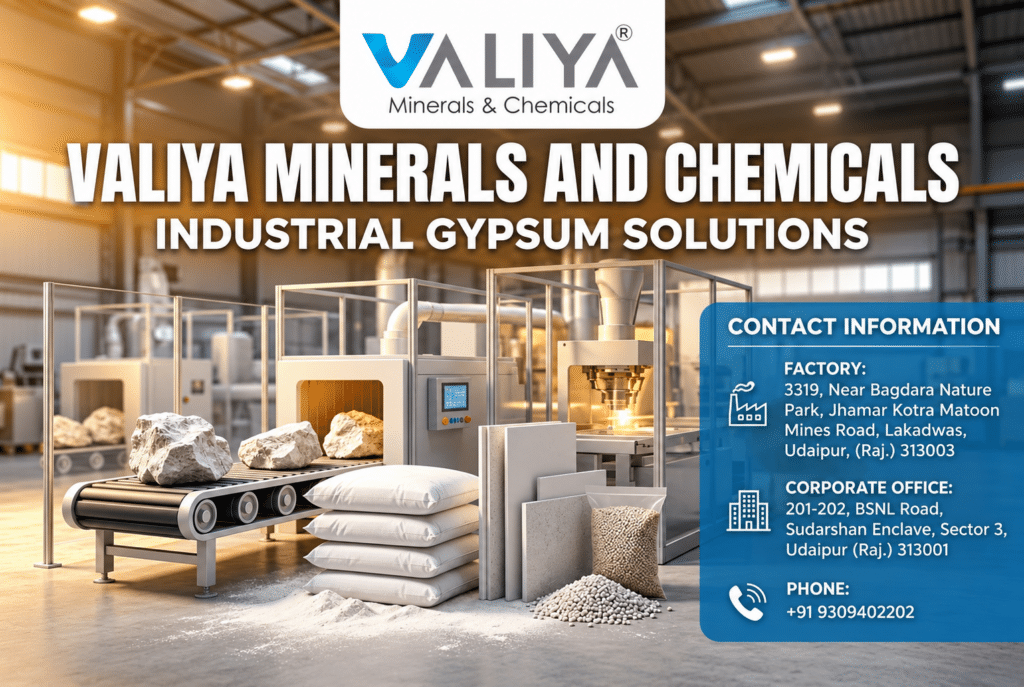
Cement plants, plaster units and construction material makers all depend on small inputs that quietly decide the quality of the final product. Gypsum is one of them. A weak or inconsistent supply can disturb setting time, slow down grinding and raise rejection rates. That is why reliable industrial gypsum solutions have become a priority for manufacturers across the country. This article explains how industrial gypsum works, where they are used, what buyers should check before placing an order, and how Valiya Minerals and Chemicals supports Indian businesses with dependable bulk supply from Udaipur, Rajasthan.
What Are Industrial Gypsum Solutions?
Industrial gypsum is a naturally occurring calcium sulfate mineral (CaSO₄·2H₂O). After processing and grading, it becomes a raw material for cement, plaster, gypsum boards and other industrial products. When we talk about industrial gypsum solutions, we mean more than a bag or a truckload of minerals. We mean a complete supply arrangement: controlled purity, steady composition, managed moisture, bulk availability and dependable logistics. For a buyer, good industrial gypsum solutions reduce surprises. The material that arrives in the third month should behave the same way as the material that arrived in the first. That consistency is what keeps production lines running without constant adjustments. You can read about the full product range on our industrial gypsum page, which lists grades, specifications and supply details.
Why Indian Businesses Need Dependable Industrial Gypsum Solutions
India’s construction and infrastructure sector keeps expanding. Housing projects, highways, metro lines, warehouses and industrial parks all need cement and building materials in large volumes. Every one of these products relies on raw materials that must perform predictably.
Here is why dependable industrial gypsum solutions matter to Indian manufacturers:
- Production continuity. Cement and plaster plants run for long hours. A delay in raw material can stop a line and increase cost.
- Product quality. Gypsum content affects how cement sets and how plaster behaves on a wall. Poor input leads to poor output.
- Cost control. Material with stable moisture and purity wastes less during grinding, handling and storage.
- Planning confidence. Buyers can schedule dispatches and stock levels when the supplier is consistent.
Because the country is large and industrial clusters are spread across many states, supply reliability also depends on location and freight planning. A supplier positioned near mineral processing zones has a natural advantage here.
The Role of Industrial Gypsum Solutions in Cement Manufacturing
The cement industry is the largest user of industrial gypsum. During clinker grinding, a controlled amount of gypsum is added to the clinker. Without it, cement would harden almost instantly after mixing with water, a problem known as flash setting. Gypsum reacts with tricalcium aluminate during hydration and slows that reaction down. This gives masons and contractors enough working time to mix, place and finish concrete or mortar. The result is better workability and a more even strength gain over time. For cement producers, two parameters matter most: the SO₃ content and the purity of the gypsum. High and consistent SO₃ makes it easier to control the sulfate balance in finished cement. This is the reason cement plants prefer suppliers who can maintain stable chemistry from batch to batch.
Good industrial gypsum solutions for cement plants therefore include:
- Verified SO₃ levels in the range needed for clinker grinding
- Controlled moisture so the material feeds smoothly into the grinding circuit
- Bulk dispatch that matches the plant’s daily consumption
- A supplier who responds quickly when quantity or timing changes
Applications Across Construction and Manufacturing
Cement is only the beginning. Industrial gypsum supports several other segments, and each one benefits from well-planned industrial gypsum solutions.
Wall Putty and Building Plasters
Wall putty and plaster products need a calcium sulfate source that behaves in a predictable way. Consistent composition helps the finished surface set evenly, take paint well and resist surface defects. Manufacturers who prepare these products in large batches value uniform raw material above everything else.
Plaster of Paris
Plaster of Paris is made by heating gypsum so that part of its water content is released. It is widely used for moulding, wall finishing, false ceilings and decorative work. Higher purity gypsum generally produces a cleaner and more reliable plaster.
Gypsum Boards and Ceiling Tiles
Modern interiors use gypsum boards and ceiling tiles for partitions and false ceilings. These products need raw material with steady purity and controlled moisture, because variation can affect board strength, weight and surface finish. Suitable industrial gypsum solutions help board makers keep their output within quality limits.
Prefabricated Construction Elements
Precast panels and prefabricated components are growing in popularity because they save time at the construction site. Their manufacturers need materials that perform the same way in every cycle, which again points to the value of a stable supplier.
Other Industrial Uses
Industrial gypsum is also used as a filler in some processes, in chemical manufacturing and in soil treatment at industrial scale. For farm-focused needs, Valiya Minerals and Chemicals also offers Agriculture Phosphogypsum, a separate product designed for agricultural use.
Technical Specifications That Buyers Should Know
Before choosing a supplier, it helps to compare technical values. The table below shows the typical properties of the gypsum supplied by Valiya Minerals and Chemicals.
| Property | Value |
| Purity (CaSO₄·2H₂O) | 85% – 95% |
| SO₃ Content | 40% – 45% |
| CaO Content | 29% – 32% |
| Moisture | Controlled |
| Form | Loose bulk |
These numbers matter for different reasons when you plan industrial gypsum solutions. Purity tells you how much of the material is actual gypsum. SO₃ content shows the sulfate level, which is critical for cement. CaO content reflects the calcium portion of the mineral. Controlled moisture decides how easily the material moves through conveyors, hoppers and grinders.
When a supplier shares these values openly and keeps them steady, it becomes much easier to build long-term industrial gypsum solutions around that supplier.
What to Check Before Buying Industrial Gypsum
Choosing a gypsum supplier is a business decision with real cost implications. These points deserve attention before you commit to a contract:
- Purity range. Ask for the minimum and maximum values and how often they are tested.
- SO₃ content. For cement use, confirm that the level suits your clinker grinding process.
- Moisture level. Wet material clumps, blocks feeders and increases transport weight without adding value.
- Supply capacity. The supplier should be able to meet your monthly volume without frequent delays.
- Location and logistics. Distance affects freight cost and delivery time. Road and rail options give flexibility.
- Communication. A responsive team makes problem solving much faster when schedules change.
A supplier who answers these points clearly is more likely to provide dependable industrial gypsum solutions over the long term.
Why Choose Valiya Minerals and Chemicals?
Valiya Minerals and Chemicals is a manufacturer and supplier based in Udaipur, Rajasthan. The company serves cement, construction and manufacturing clients across India. Its approach to industrial gypsum solutions rests on a few clear strengths:
- Manufacturing unit in Udaipur. The facility is located in Lakadwas, close to mineral processing zones. This supports cost-effective and timely supply.
- High purity of 85% to 95%. Consistent quality from one batch to the next helps buyers plan production with confidence.
- SO₃ content of 40% to 45%. This range suits cement clinker grinding and many construction uses.
- Controlled moisture. The material is easier to handle, grind and store without clumping.
- Loose bulk supply. Ideal for cement plants, construction material makers and industrial buyers who consume large volumes.
- Pan India dispatch. Material moves by road and rail to major industrial states.
You can learn more about the company’s background and values on the About Us page. The company also manufactures Dicalcium Phosphate (DCP) for the animal feed and fertilizer industry, which shows its wider experience in minerals and chemicals.
Industrial Gypsum Solutions Coverage Across India
Valiya Minerals and Chemicals dispatches from its factory in Udaipur to buyers in many regions:
- Rajasthan: Udaipur, Chittorgarh, Bhilwara, Kota, Jaipur, Ajmer and Jodhpur
- Gujarat: Ahmedabad, Surat, Vadodara and Rajkot
- Madhya Pradesh: Indore, Bhopal and Ratlam
- Other states: Maharashtra, Uttar Pradesh, Haryana, Punjab and Karnataka
This reach makes the company a practical partner for regional and national buyers who want dependable industrial gypsum solutions without depending on several different vendors.
Who Can Benefit from Industrial Gypsum Solutions?
The following businesses can gain from steady bulk gypsum supply:
- Cement manufacturers and cement plants
- Producers of wall putty, plaster and prefabricated elements
- Gypsum board and ceiling tile manufacturers
- Industrial buyers and bulk traders who need factory-direct material
- Export-oriented companies that want a consistent Indian source
If your business falls in any of these groups, the right industrial gypsum solutions can improve production stability and reduce hidden costs.
Tips for Handling and Storing Bulk Gypsum
Even high quality industrial gypsum solutions can lose value if the material is stored poorly. A few simple practices protect your stock:
- Store gypsum on a clean, raised or paved surface so it stays away from standing water.
- Cover stockpiles during the rainy season to avoid extra moisture.
- Keep different material lots separate so that quality can be traced easily.
- Use first-in, first-out stock rotation to avoid long storage periods.
- Check moisture regularly before feeding the material into grinders.
Careful handling supports the performance that good industrial gypsum solutions are designed to deliver.
Frequently Asked Questions
What are industrial gypsum solutions used for?
Industrial gypsum is mainly used in cement manufacturing to control setting time. It is also used in plaster, wall putty, gypsum boards, ceiling tiles and several other industrial processes.
How does gypsum help in cement production?
Gypsum slows the reaction of tricalcium aluminate during hydration. This prevents flash setting and gives workers enough time to handle the mix.
What purity does Valiya Minerals and Chemicals offer?
The company supplies industrial gypsum with a purity range of 85% to 95% and SO₃ content of 40% to 45%. Full details are available on the industrial gypsum page.
In what form is the material supplied?
It is supplied in loose bulk form with controlled moisture, which suits large-scale plants and manufacturing units.
How can I get a quote or know the minimum order quantity?
Since supply is focused on bulk requirements, quotes and minimum order quantity depend on your location and volume. You can share your requirement through the enquiry form or reach the team through the Contact Us page.
Conclusion
Strong products begin with dependable raw materials. For cement plants, plaster makers and construction material manufacturers, consistent purity, controlled moisture and reliable bulk delivery are not optional extras. They are the base of stable production. Choosing the right industrial gypsum helps businesses protect quality, manage cost and plan with confidence. Valiya Minerals and Chemicals combines a well-located Udaipur facility, clear technical specifications and pan India dispatch to serve this need. If your business is looking for steady industrial gypsum solutions, share your requirement today through the enquiry page or call +91 9309402202 to discuss quantity, pricing and delivery.