
Phosphogypsum quality parameters decide whether your soil amendment delivers results or wastes your money. Soil fatigue, sodic patches and sulphur-hungry crops are now common sights across Indian farmland, and more farmers, fertilizer blenders and soil reclamation contractors are turning to Agriculture Phosphogypsum to fix them. It is affordable, rich in calcium and sulphur, and available in bulk. However, the results you get in the field depend entirely on the material you buy. Two lots may look identical on a truck, yet behave very differently once they reach the soil.
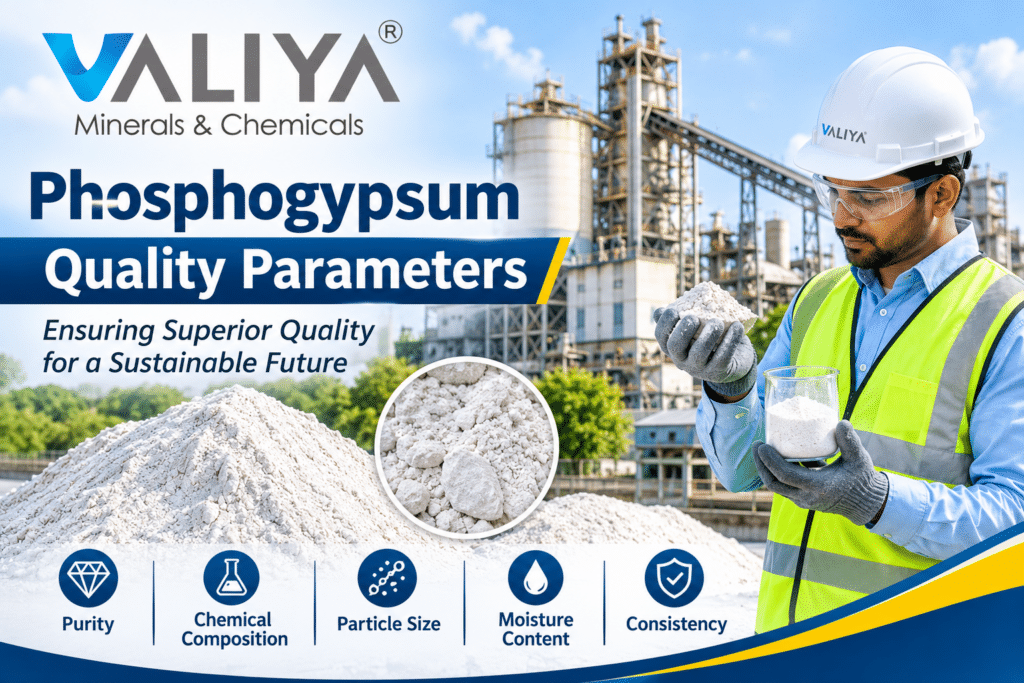
What Is Agriculture Phosphogypsum?
Agriculture Phosphogypsum is calcium sulphate dihydrate (CaSO₄·2H₂O) that forms as a byproduct when phosphate rock is processed into phosphoric acid. After suitable processing, it becomes a useful soil conditioner and a source of secondary nutrients. It supplies calcium and sulphur, and it often carries a small amount of phosphorus as P₂O₅.
Unlike mined gypsum, Agriculture Phosphogypsum can deliver this extra phosphorus along with its calcium and sulphur. Because it originates from an industrial process, its composition changes from one plant and one batch to another. Therefore, a buyer cannot assume that every lot meets the same standard. Checking phosphogypsum quality parameters is the only reliable way to protect your investment, your soil and your crop.
Why Phosphogypsum Quality Parameters Matter for Indian Farmers and Buyers
India has large areas of saline, sodic and calcium-deficient soils, especially in Rajasthan, Gujarat, Haryana, Punjab and Uttar Pradesh. Crops such as groundnut, mustard, sugarcane, cotton and pulses draw heavily on calcium and sulphur. When the amendment is weak or contaminated, three things happen:
- You apply more material than you planned, which raises transport and labour costs.
- Soil improvement is slow, so crop response disappoints.
- Unwanted impurities may reach the soil over repeated seasons.
A buyer who reads a test report with confidence avoids all three problems. The sections below cover the phosphogypsum quality parameters that deserve the most attention.
1. Gypsum Purity (CaSO₄·2H₂O Content): The First of the Phosphogypsum Quality Parameters
Purity is the first of the phosphogypsum quality parameters to check. It shows how much of the material is actual calcium sulphate dihydrate. Higher purity means more calcium and sulphur in every tonne you pay for. For reference, pure gypsum holds roughly 23 percent calcium and about 18 to 19 percent sulphur. Real-world material carries less than this because of impurities, so the purity percentage tells you how close a lot comes to that ideal. Good-quality Agriculture Phosphogypsum for farm use is typically offered in the range of 85 to 95 percent purity. A lot far below that range delivers fewer nutrients per bag and raises your cost per unit of calcium and sulphur. Always ask the supplier for purity on a dry-matter basis, and confirm that the figure comes from a laboratory test and not from a verbal claim.
2. Moisture Content
Among phosphogypsum quality parameters, moisture affects almost every practical aspect of handling. Freshly produced phosphogypsum is wet, and some of that water is surface moisture while some is chemically bound as water of crystallisation. Buyers should focus on free moisture, which is the surface water you can dry off.
High free moisture creates several problems:
- You pay freight on water instead of product.
- The material clumps, which makes spreading uneven.
- Storage becomes difficult during the monsoon.
- Blending with other fertilizers becomes unreliable.
Controlled moisture, one of the most practical phosphogypsum quality parameters, keeps the product free-flowing and easier to apply with farm equipment or blending machinery. When you compare quotations, make sure the rates are based on a similar moisture level. A cheaper rate for wet material often turns out more expensive per tonne of usable gypsum.
3. P₂O₅ Content in Phosphogypsum Quality Parameters
The residual phosphorus in Agriculture Phosphogypsum is one of its real advantages among phosphogypsum quality parameters, because it gives the crop a small phosphorus benefit on top of calcium and sulphur. Material with P₂O₅ up to about 3 percent adds value for crops that respond to phosphorus. When reviewing this entry in a lab report, check two things. First, ask for the total P₂O₅ value. Second, find out how much of it is water-soluble, since this portion is the fraction plants can access quickly. A consistent P₂O₅ level across batches also tells you that the upstream process is stable.
4. pH and Free Acidity in Phosphogypsum Quality Parameters
Phosphogypsum can retain traces of acid from the phosphoric acid process. When the material is not properly neutralised or washed, its pH may be low, and free acidity can be high. This is one of the more serious phosphogypsum quality parameters, because:
- Strongly acidic material can stress seedlings if applied near the root zone.
- It may corrode storage and handling equipment.
- It can disturb the pH balance in sensitive or already acidic soils.
Quality Agriculture Phosphogypsum should have a stable, near-neutral to mildly acidic pH, supported by a test report. If a supplier cannot share a pH value, treat it as a warning sign.
5. Fluoride Content
Fluoride is another of the phosphogypsum quality parameters worth checking. Phosphate rock contains fluorine, and a part of it may remain in the byproduct. Excess soluble fluoride is undesirable in agricultural soil, so responsible suppliers monitor it. Ask for a fluoride value in the lab report, and prefer sources that process their material to keep soluble fluoride low.
6. Heavy Metals
Heavy metals are among the phosphogypsum quality parameters that deserve careful attention because they can build up in the soil over time. The elements usually tested include cadmium, lead, arsenic, chromium, nickel and mercury. Their levels depend largely on the origin of the phosphate rock used in the plant. Reputable manufacturers test for these elements regularly and keep them within permissible limits. If you plan to apply Agriculture Phosphogypsum year after year, heavy metal data becomes even more important, because small amounts repeat across seasons. Ask whether the supplier’s test report covers these metals, and compare the values with the limits set by Indian regulations and fertilizer standards.
7. Radioactivity (Radium-226)
Phosphate rock naturally contains traces of uranium and its decay products, and some of these can pass into phosphogypsum. Radium-226 is the element most often measured. Reliable producers monitor radioactivity as part of routine quality control and follow the safety limits prescribed by national authorities. Most farm buyers cannot measure radioactivity themselves, one of the key phosphogypsum quality parameters, so the practical step is simple. Buy from a manufacturer that checks radioactivity and is willing to discuss the results openly. Transparency here is a strong sign of a responsible supplier.
8. Particle Size and Physical Form
Particle size influences how fast the gypsum dissolves and reacts in the soil. Fine particles dissolve quicker and act faster, whereas coarse lumps dissolve slowly and leave patchy results. Uniform, well-processed material spreads evenly and blends well with other inputs. Check that the material is free from large lumps, stones and foreign matter. Loose bulk supply, as many Indian fertilizer blenders and agri distributors prefer, works well when the physical form is consistent across deliveries.
9. Soluble Salts: Sodium and Chloride
Soluble salts also count among the phosphogypsum quality parameters. Because the aim of using gypsum is often to reclaim saline and sodic land, the amendment itself must not add more salt. Elevated sodium or chloride in the material works against the goal of reclamation. Ask for soluble salt data, particularly if you are working on sodic soil projects.
10. Batch-to-Batch Consistency
Consistency is the last of the phosphogypsum quality parameters, and one good test report is not enough. A dependable supplier delivers the same purity, moisture and chemistry lot after lot. Consistency allows you to calculate the application rate with confidence, and it makes planning easier for fertilizer manufacturers who blend Agriculture Phosphogypsum into their own products. To judge consistency across phosphogypsum quality parameters, request test reports from several recent dispatches and compare them. Wide swings between reports suggest weak process control.
How to Verify Phosphogypsum Quality Parameters Before You Buy
Knowing the phosphogypsum quality parameters is useful, but you also need a practical method to verify them. Follow these steps:
- Request a recent test report. It should come from a recognised laboratory and mention the batch or date.
- Ask for a sample before bulk orders. Test it independently if your order is large.
- Compare reports over time. Check that purity, moisture and P₂O₅ stay steady.
- Match the grade to your use. A fertilizer blender, a farm owner and a reclamation contractor may each prioritise different phosphogypsum quality parameters.
- Check the supplier’s location and logistics. Shorter distances reduce freight cost and the risk of moisture pick-up during transit.
Why Buyers in India Trust Valiya Minerals and Chemicals
Valiya Minerals and Chemicals understands phosphogypsum quality parameters well. It is a manufacturer and supplier of Agriculture Phosphogypsum in Udaipur, Rajasthan, serving clients across India. The company supplies agri grade material with 85 to 95 percent purity, P₂O₅ up to 3 percent and controlled moisture, in loose bulk form that suits fertilizer blenders, distributors and large farms. The manufacturing unit in Lakadwas, Udaipur, sits close to key mineral processing zones, which supports quick dispatch to Rajasthan, Gujarat, Madhya Pradesh, Maharashtra, Uttar Pradesh, Haryana, Punjab and Karnataka by road and rail. If your work also needs construction or industrial input, the company supplies industrial grade gypsum as well. For animal feed and fertilizer applications, you can also explore its Dicalcium Phosphate (DCP) range.
Frequently Asked Questions
Which phosphogypsum quality parameters matter most for farmers?
Purity, moisture, P₂O₅ content, pH and heavy metal levels matter most. Together they decide nutrient value, ease of application and long-term soil safety.
Is high moisture in phosphogypsum a problem?
Yes. Extra free moisture adds to freight cost, causes clumping and makes spreading uneven. Controlled moisture gives better handling and storage.
What purity should Agriculture Phosphogypsum have?
For farm use, a purity range of about 85 to 95 percent is considered good. Higher purity means more calcium and sulphur per tonne.
Can phosphogypsum help reclaim sodic soils?
Yes. The calcium in gypsum replaces sodium on soil particles, which improves structure and water movement. Choose material with low soluble salts for this purpose.
How do I check phosphogypsum quality parameters for consistency?
Request test reports from several recent batches and compare purity, moisture and P₂O₅. Stable values across reports indicate good process control.
Does Valiya supply across India?
Yes. Valiya Minerals and Chemicals supplies loose bulk Agriculture Phosphogypsum from Udaipur, Rajasthan to buyers across India.

Conclusion
Strong crop response starts with reliable inputs and a clear grasp of phosphogypsum quality parameters. When you check purity, moisture, P₂O₅, pH, fluoride, heavy metals, radioactivity, particle size, soluble salts and batch consistency, you master the key phosphogypsum quality parameters and remove most of the risk from buying Agriculture Phosphogypsum. A supplier who shares lab data openly, delivers uniform material and understands Indian soil conditions makes your decision easier. Ready to source quality material for your farm, blending unit or reclamation project? Visit our Agriculture Phosphogypsum page to see specifications, then reach out to the Valiya team to request a bulk quote and a sample test report.