
In the animal feed industry, the quality of mineral supplements directly determines the health, growth, and productivity of livestock and poultry. Among all available phosphorus and calcium sources, rock based dicalcium phosphate has consistently proven to be the most effective, safest, and nutritionally superior option for feed manufacturers worldwide. Rock based dicalcium phosphate is not just a mineral additive it is a scientifically validated, feed-grade nutritional compound that delivers measurable results in poultry performance, cattle productivity, and aquaculture growth rates. Its unique origin from natural rock phosphate, combined with a clean sulphuric acid manufacturing process, sets it apart from synthetic or waste-derived DCP alternatives. As a leading dicalcium phosphate manufacturer in Udaipur, Valiya Minerals & Chemicals has been producing high-grade rock based dicalcium phosphate for over 15 years, serving animal feed manufacturers across Rajasthan, India, and international markets. In this blog, we go deep into why rock based dicalcium phosphate is the gold standard in animal feed mineral supplementation and why the source and process behind your DCP matters more than you think.
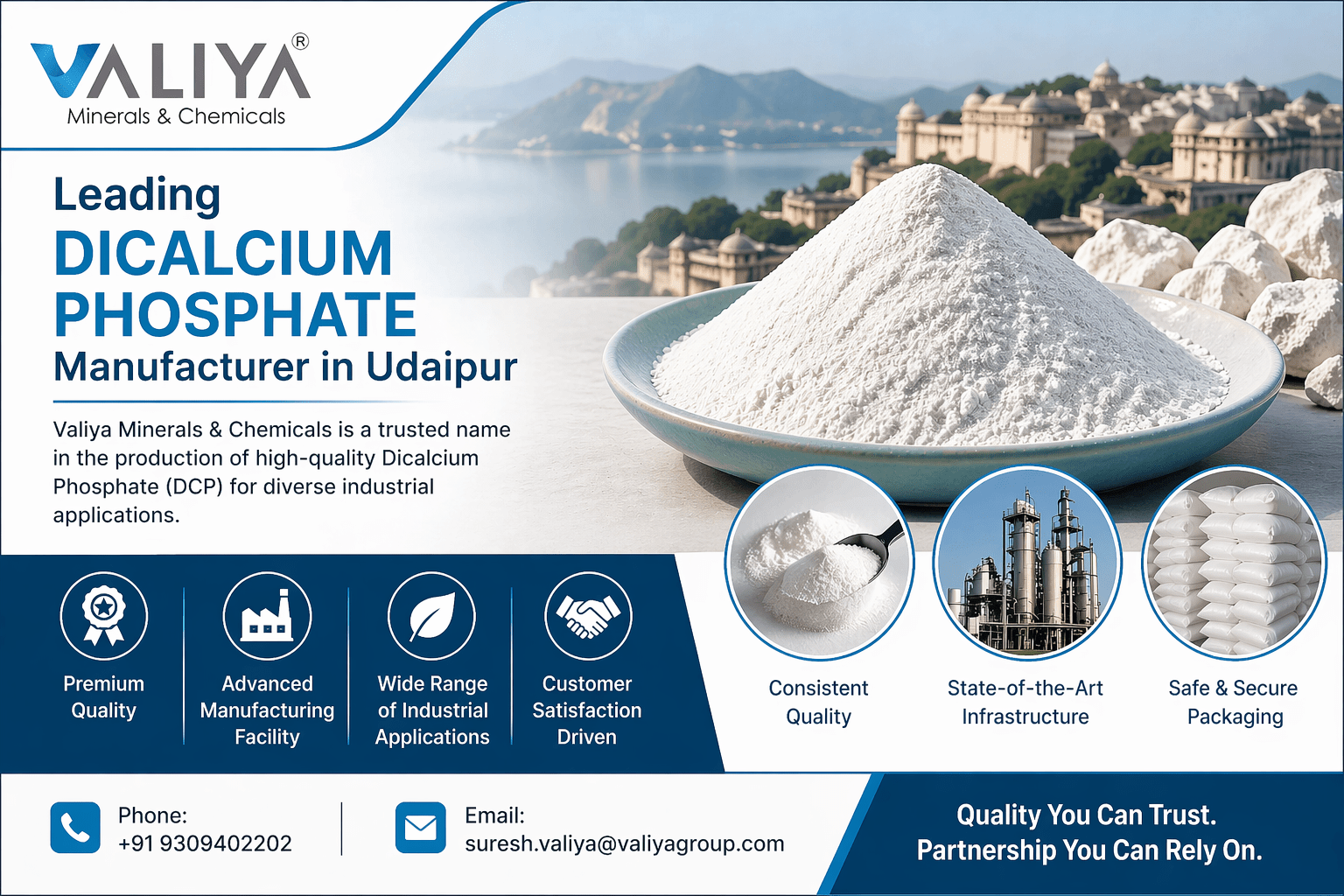
What Is Rock-Based Dicalcium Phosphate?
Dicalcium Phosphate (DCP) is an inorganic mineral compound with the chemical formula CaHPO₄. It is one of the most widely used feed-grade mineral supplements globally, serving as a primary dietary source of both calcium and phosphorus for animals.
Rock based dicalcium phosphate specifically refers to DCP that is derived from natural, high-grade rock phosphate ore as its primary raw material. The rock phosphate is reacted with high-grade sulphuric acid under controlled manufacturing conditions to produce a white, odorless, free-flowing powder consistent in composition, safe in heavy metal levels, and high in phosphorus bioavailability.
What makes rock based dicalcium phosphate different from other DCP variants is precisely this origin. Unlike DCP manufactured from hydrochloric acid processes or industrial waste streams, rock-based DCP maintains its mineral integrity from raw material to final product. The result is a feed supplement that animal nutritionists and feed compounders trust for its predictability, safety, and nutritional performance.
Why Rock-Based Dicalcium Phosphate Is Better for Animal Feed
1. Superior Phosphorus Bioavailability
The single most important parameter of any DCP product is how much of its phosphorus content is actually absorbed and used by the animal. Rock based dicalcium phosphate manufactured through the sulphuric acid process delivers significantly higher phosphorus bioavailability compared to alternatives derived from waste acids or inferior rock sources.
High bioavailability means that poultry, cattle, and aquaculture species extract maximum nutritional value from each gram of DCP added to the feed mix. This directly translates into better feed conversion ratios, faster growth rates, and reduced total feed cost per kilogram of animal weight gain making rock based dicalcium phosphate not just a healthier choice, but a more economical one for feed manufacturers.
2. Balanced and Consistent Calcium-to-Phosphorus Ratio
One of the greatest challenges in feed formulation is maintaining a precise and consistent calcium-to-phosphorus (Ca:P) ratio across production batches. Rock based dicalcium phosphate, when produced under strict quality controls, delivers a highly stable and repeatable mineral profile typically around 29% calcium and 18–22% phosphorus on a moisture-free basis.
This consistency is vital. In poultry, an imbalanced Ca:P ratio leads to poor eggshell quality, leg weakness, and reduced laying performance. In dairy cattle, it causes milk fever, reduced reproductive efficiency, and compromised skeletal health. By choosing rock based dicalcium phosphate from a verified manufacturer, feed compounders eliminate the risk of batch-to-batch variation that can silently damage animal performance over time.
3. Produced Without Hazardous Waste Acids
Not all DCP is manufactured equally. A significant portion of low-cost DCP available in the market is produced using hydrochloric acid a process that introduces chloride contamination or even worse, using industrial waste acids that carry unpredictable heavy metal loads.
Rock based dicalcium phosphate produced by Valiya Minerals & Chemicals is manufactured exclusively using high-grade sulphuric acid. This clean production route avoids hazardous waste inputs, ensures chemical purity, and complies with feed safety regulations. It is a process-sensitive, technically demanding manufacturing method and it is what separates genuine rock-based DCP from cheaper, riskier alternatives flooding the market.
4. Controlled Heavy Metal Levels Safe for Animals and the Food Chain
Heavy metal contamination in DCP — particularly fluorine, lead, arsenic, and cadmium — is a serious concern for feed manufacturers and regulatory authorities. Elevated fluorine in DCP is especially dangerous, as it accumulates in animal bones and soft tissues over time, causing fluorosis, reduced productivity, and long-term health damage.
Rock based dicalcium phosphate sourced from quality-controlled rock phosphate mines and processed correctly maintains tight control over fluorine and other heavy metal levels. At Valiya Minerals & Chemicals, every batch undergoes laboratory testing for calcium, phosphorus, fluorine, lead, arsenic, acid insoluble ash, and total ash ensuring that DCP leaving the facility meets all required feed-grade safety parameters.
5. Improved Bone Density and Skeletal Development
Calcium and phosphorus are the two primary building blocks of bone tissue in animals. A deficiency or imbalance of either leads to poor bone mineralisation, rickets in young animals, leg disorders in broilers, and fractures in laying hens. Rock based dicalcium phosphate supplies both minerals in a bioavailable, well-balanced form that directly supports healthy skeletal development across all animal species.
Broiler chickens supplemented with high-quality rock based dicalcium phosphate show measurably stronger tibia bones, better walking ability, and reduced condemnation rates at processing. Dairy cattle benefit from stronger hooves, reduced lameness, and improved reproductive performance. These are not marginal gains they are commercially significant improvements that feed manufacturers and livestock producers experience directly.
6. Enhanced Egg Production and Eggshell Quality in Poultry
For layer operations, rock based dicalcium phosphate plays a particularly critical role. Eggshell formation requires massive daily calcium mobilisation from the hen’s skeletal reserves and dietary intake. When DCP quality is compromised whether through low phosphorus content, inconsistent Ca:P ratios, or elevated fluorine the effect on eggshell strength and laying rate becomes visible almost immediately.
High-purity rock based dicalcium phosphate ensures that layer hens have a reliable, consistent supply of both calcium and phosphorus throughout their productive cycle, resulting in better eggshell thickness, reduced breakage during handling, and sustained laying performance over a longer production period.
7. Better Feed Conversion Efficiency and Growth in Broilers
In broiler production, feed cost accounts for 65–70% of total production expenses. Every unit improvement in feed conversion ratio (FCR) has a direct financial impact on farm profitability. Rock based dicalcium phosphate with high phosphorus bioavailability contributes to efficient energy metabolism, better nutrient utilisation, and faster muscle development in broilers.
Feed manufacturers who switch from low-quality DCP to high-grade rock based dicalcium phosphate consistently report measurable improvements in FCR, reduced days to target weight, and lower flock mortality all of which compound into significant economic benefits at scale.
8. Essential for Aquaculture and Fish Feed Formulation
Phosphorus is an absolutely essential nutrient for fish and shrimp required for skeletal formation, energy metabolism, cellular function, and enzyme activity. Unlike terrestrial animals, aquatic species cannot efficiently absorb phosphorus from plant-based sources, making rock based dicalcium phosphate a critical and irreplaceable ingredient in aquafeed formulations.
High-quality rock based dicalcium phosphate improves growth performance, feed intake, and survival rates in fish and shrimp species. It also reduces phosphorus wastage into water bodies a key environmental consideration for sustainable aquaculture operations.
9. Reliable Performance in Cattle and Dairy Feed
Calcium and phosphorus deficiencies are among the leading causes of production losses in dairy farming. Cows with inadequate phosphorus intake show reduced appetite, decreased milk production, poor body condition, and reproductive failure. Rock based dicalcium phosphate supplementation in cattle feed corrects these deficiencies efficiently, restoring metabolic balance and supporting peak milk production performance.
For beef cattle, rock based dicalcium phosphate promotes faster weight gain, stronger bone structure, and better feed utilisation — directly improving the economics of beef production for farmers and integrators.
About Valiya Minerals & Chemicals
Valiya Minerals & Chemicals, formerly known as JS Minchem, is a trusted name in the phosphate mineral industry, backed by over three decades of group-level manufacturing experience. Operating from the Gudli Industrial Area, Udaipur, Rajasthan, the company has dedicated over 15 years specifically to the manufacturing of rock based dicalcium phosphate for the animal nutrition and feed industry.
With an installed production capacity of 27,000 MT per annum, Valiya Minerals & Chemicals is one of the largest dedicated DCP manufacturers in the region. The company maintains strict batch-wise quality testing for all critical parameters — calcium, phosphorus, fluorine, lead, arsenic, acid insoluble ash, and moisture — ensuring every consignment meets feed-grade specifications without compromise.
Valiya Minerals & Chemicals is supported by a logistics network of over 300 owned vehicles, enabling reliable bulk delivery across all major states in India and supporting international export orders with full documentation and packaging compliance.
Beyond DCP, Valiya Minerals & Chemicals is part of the broader Valiya Group, which manufactures Single Super Phosphate (SSP), Mineral Gypsum, Rock Phosphate, Hydrated Lime, and Limestone Powder — making it a one-stop mineral solutions provider for agriculture, animal feed, and chemical processing industries.
Applications of Rock-Based Dicalcium Phosphate in Animal Feed
Poultry Feed: Supports eggshell quality, bone strength, improved FCR, and sustained laying performance in broilers and layers.
Cattle and Dairy Feed: Improves milk yield, reproductive performance, hoof health, and skeletal integrity in dairy cows and buffaloes.
Aquaculture Feed: Delivers essential phosphorus for fish and shrimp growth, energy metabolism, and survival rates in intensive aquaculture systems.
Swine Feed: Supports bone mineralisation, growth rate, and overall metabolic health in pigs at all production stages.
Sheep and Goat Feed: Maintains healthy bone structure, reproductive efficiency, and milk production in small ruminants.
Frequently Asked Questions (FAQs)
Q1. What is rock-based dicalcium phosphate and why is it used in animal feed? Rock based dicalcium phosphate is a feed-grade mineral supplement derived from natural rock phosphate, processed using sulphuric acid. It is used in animal feed to provide both calcium and phosphorus — essential nutrients for bone development, growth performance, egg production, and metabolic health across poultry, cattle, and aquaculture species.
Q2. How is rock-based DCP better than acid-waste-derived DCP? Rock based dicalcium phosphate offers higher purity, better phosphorus bioavailability, lower heavy metal contamination, and consistent Ca:P ratios. DCP derived from hydrochloric acid or industrial waste streams carries higher risks of chloride contamination, elevated fluorine, and variable mineral composition — all of which negatively impact animal health and feed safety.
Q3. Why does phosphorus bioavailability matter in DCP selection? Higher phosphorus bioavailability means animals absorb and utilise more phosphorus from each gram of DCP in the feed. This directly improves feed conversion ratios, reduces total feed cost, supports skeletal development, and enhances reproductive and production performance across all livestock and poultry species.
Q4. What heavy metals should I check in feed-grade DCP? When evaluating rock based dicalcium phosphate quality, check for fluorine, lead, arsenic, cadmium, and acid insoluble ash levels. Elevated fluorine is particularly dangerous, causing fluorosis and long-term health damage in animals. Always source DCP from manufacturers who provide batch-wise laboratory certificates with full heavy metal analysis.
Q5. What is the standard mineral composition of feed-grade rock-based DCP? High-quality rock based dicalcium phosphate typically contains approximately 29% calcium and 18–22% phosphorus on a moisture-free basis, with fluorine levels well within prescribed feed safety limits. All values for calcium, phosphorus, fluorine, and heavy metals should be reported on a moisture-free basis by the manufacturer.
Q6. Who is the leading dicalcium phosphate manufacturer in Udaipur? Valiya Minerals & Chemicals is the leading dicalcim phosphate manufacturer in Udaipur, with over 15 years of dedicated rock based dicalcium phosphate manufacturing experience, a production capacity of 27,000 MT per annum, strict batch-wise quality controls, and a reliable supply network across Rajasthan, India, and international export markets.
Q7. Does Valiya Minerals & Chemicals offer bulk DCP supply? Yes. Valiya Minerals & Chemicals offers bulk supply of rock based dicalcium phosphate with standard industrial packaging suitable for large-scale feed manufacturers, compounders, and distributors across India and for export orders.
Q8. Can Valiya Minerals & Chemicals deliver DCP across India? Yes. Valiya Minerals & Chemicals supplies rock based dicalcium phosphate from its Udaipur manufacturing facility to customers across all major states in India, supported by a dedicated logistics fleet of over 300 owned vehicles ensuring timely and uninterrupted delivery.
Q9. Does Valiya Minerals & Chemicals export rock-based DCP internationally? Yes. Valiya Minerals & Chemicals exports feed-grade rock based dicalcium phosphate to international markets and handles bulk export orders with proper packaging, documentation, quality certification, and logistics coordination.
Q10. How do I get technical specifications or place a bulk order? You can contact Valiya Minerals & Chemicals directly through their website at valiyamineralsandchemicals.com to request product specifications, technical data sheets, quality certificates, and bulk pricing for rock based dicalcium phosphate.
Conclusion
The advantages of rock based dicalcium phosphate over alternative DCP sources are clear, measurable, and commercially significant from superior phosphorus bioavailability and consistent mineral ratios to safer heavy metal profiles and better animal productivity outcomes. The difference between good DCP and great DCP lies in raw material quality, manufacturing process integrity, and rigorous quality testing standards that not every supplier upholds. As the leading dicalcium phosphate manufacturer in Udaipur, Valiya Minerals & Chemicals delivers rock based dicalcium phosphate that feed manufacturers across India and global markets trust for consistency, purity, and performance batch after batch, year after year. When you choose Valiya Minerals & Chemicals, you are not just buying a mineral supplement you are partnering with a manufacturer who understands animal nutrition and delivers at scale with reliability.